


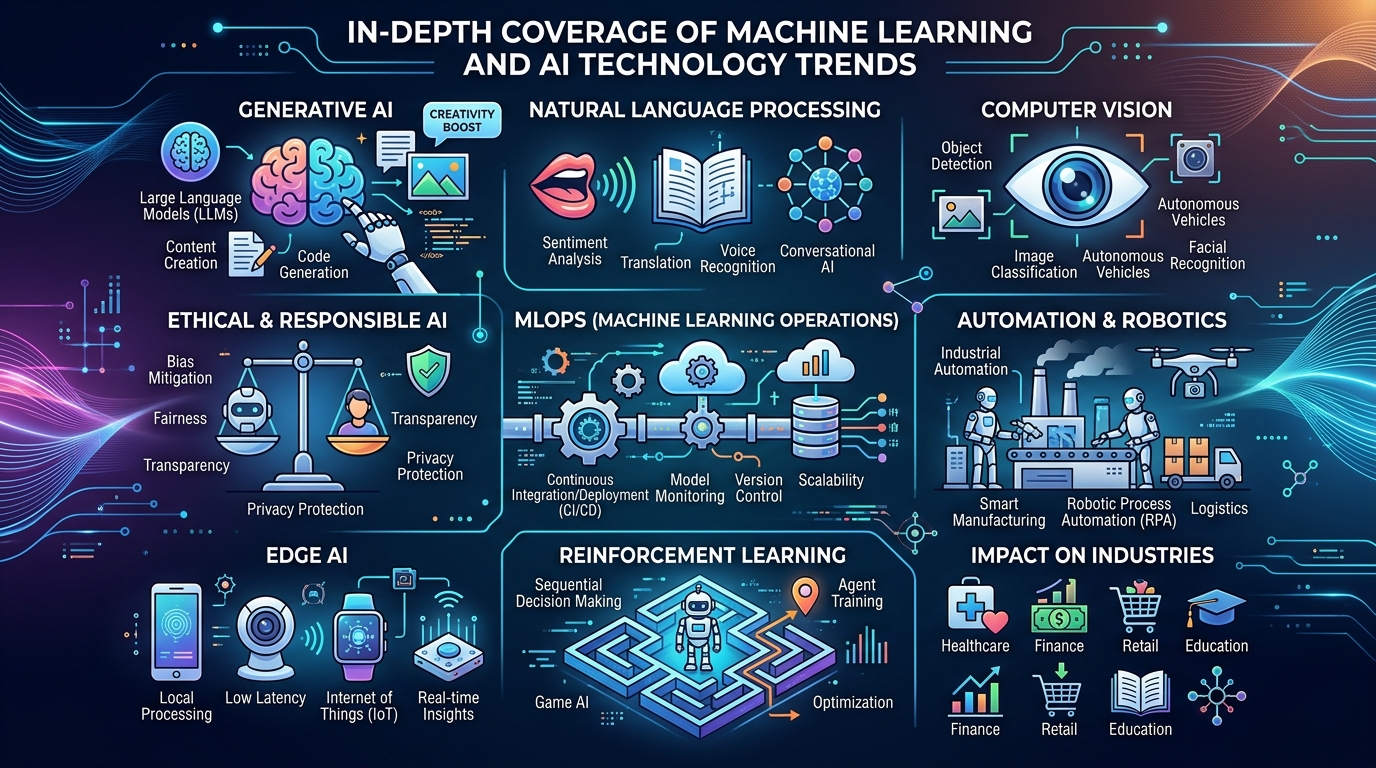
Artificial intelligence and machine learning are driving some of the most significant technological transformations of the modern era. In-depth coverage of these trends helps explain how systems are becoming smarter, more autonomous, and more integrated into daily life. From predictive analytics and generative models to robotics and ethical AI frameworks, these technologies are reshaping industries, economies, and human interaction with machines.
Evolution of Artificial Intelligence
Early Rule-Based Systems
Early AI systems relied on fixed rules and logic programmed by humans. These systems could solve limited problems but lacked adaptability and learning capability in dynamic environments.
Shift to Machine Learning Models
Modern AI shifted toward machine learning, where systems learn patterns from data instead of relying on explicit programming. This change significantly improved flexibility and performance.
Rise of Deep Learning Networks
Deep learning uses multi-layered neural networks to process complex data like images, speech, and text. It has enabled breakthroughs in facial recognition, translation, and autonomous systems.
Expansion of Generative AI
Generative AI creates new content such as text, images, audio, and video. This technology is transforming creative industries and digital content production globally.
Integration into Everyday Systems
AI is now embedded in everyday tools such as search engines, smartphones, and recommendation systems, making technology more intuitive and personalized.
Machine Learning Core Developments
Supervised Learning Improvements
Supervised learning models continue to improve through better datasets and optimized algorithms, enhancing accuracy in classification and prediction tasks.
Unsupervised Learning Advancements
Unsupervised learning helps identify hidden patterns in data without labeled inputs, widely used in customer segmentation and anomaly detection.
Reinforcement Learning Progress
Reinforcement learning enables systems to learn through rewards and penalties, powering robotics, gaming AI, and autonomous decision-making systems.
Transfer Learning Techniques
Transfer learning allows models trained on one task to be adapted to another, reducing training time and improving efficiency.
Federated Learning Systems
Federated learning trains models across decentralized devices while preserving privacy, reducing the need to centralize sensitive data.
AI Applications Across Industries
Healthcare Diagnostics
AI systems analyze medical images and patient data to detect diseases early and support doctors in diagnosis and treatment planning.
Financial Technology Systems
Banks use AI for fraud detection, credit scoring, and algorithmic trading, improving speed and accuracy in financial decision-making.
Autonomous Vehicles Development
Self-driving systems use AI to interpret surroundings, recognize objects, and make real-time driving decisions safely.
Retail and Recommendation Engines
Platforms like Amazon use machine learning to recommend products based on user behavior and preferences.
Streaming and Content Personalization
Services like Netflix use AI to personalize viewing recommendations and improve user engagement.
Emerging AI Technology Trends
Generative AI Expansion
Generative models are increasingly used for content creation, software development, and creative design tasks across industries.
Multimodal AI Systems
Multimodal AI processes text, images, audio, and video together, enabling more human-like understanding and interaction.
Edge AI Development
Edge AI processes data locally on devices, reducing latency and improving real-time decision-making in applications like IoT and mobile systems.
AI in Robotics
AI-powered robots are being used in manufacturing, healthcare, and logistics to perform complex physical and cognitive tasks.
Real-Time AI Analytics
AI systems now analyze streaming data in real time, supporting faster decision-making in finance, security, and operations.
AI in Software and Cloud Ecosystems
AI-Driven Cloud Platforms
Cloud providers like Amazon Web Services integrate AI tools to help businesses build, train, and deploy machine learning models efficiently.
Automated Software Development
AI assists developers by generating code, detecting bugs, and optimizing software performance.
Intelligent DevOps Systems
AI enhances DevOps processes by predicting system failures and automating deployment workflows.
API-Based AI Services
AI models are increasingly delivered through APIs, allowing developers to integrate intelligence into applications easily.
Scalable Machine Learning Infrastructure
Cloud-based machine learning infrastructure supports large-scale training and deployment of complex AI models.
Ethics and Challenges in AI
Data Privacy Concerns
AI systems require large datasets, raising concerns about how personal information is collected and used.
Algorithmic Bias Issues
Biased training data can lead to unfair or inaccurate AI decisions, affecting sensitive applications like hiring and lending.
Transparency and Explainability
Many AI models operate as “black boxes,” making it difficult to understand how decisions are made.
Security and Misuse Risks
AI technologies can be misused for cyberattacks, deepfakes, and misinformation campaigns.
Regulatory and Legal Challenges
Governments are developing frameworks to regulate AI usage and ensure responsible innovation.
Future of Machine Learning and AI
Artificial General Intelligence Research
Researchers are working toward systems that can perform any intellectual task a human can do, though this remains a long-term goal.
Human-AI Collaboration
Future workplaces will rely heavily on collaboration between humans and AI systems to enhance productivity and creativity.
Personalized AI Systems
AI will become highly personalized, adapting to individual preferences, behaviors, and needs in real time.
Quantum Machine Learning
Quantum computing may accelerate machine learning capabilities by processing complex data faster than classical systems.
Fully Autonomous Systems
Future AI systems may operate independently in industries like transportation, manufacturing, and logistics.
Conclusion
Machine learning and AI technology trends are transforming how systems learn, adapt, and interact with the world. From healthcare and finance to entertainment and robotics, AI is becoming deeply embedded in everyday life. As innovation continues, responsible development, ethical use, and continuous advancement will define the future of intelligent technologies and their global impact.
